
Quick View
Product Code: 
£
Basket
Skip to main content

Choosing the Right Aerospace Hydraulic Fluid for Your Aircraft

Selecting an aerospace hydraulic fluid is rarely a matter of preference. The fluid is a working component of the flight control, landing gear and braking systems, and the wrong choice can degrade seals, contaminate a system beyond economic recovery, or invalidate maintenance approval.

This guide sets out the three fluid families used in aviation, the specifications that govern them, and the practical checks that decide which fluid belongs in your aircraft. It is written for maintenance engineers, MRO teams and procurement professionals who need a defensible answer rather than a general overview.

What Aerospace Hydraulic Fluid Has to Do

Aircraft hydraulic systems typically operate at 3,000 psi, and at 5,000 psi on newer platforms. The fluid must transmit that pressure while lubricating pumps and actuators, protecting against corrosion, and remaining stable across a temperature range that swings from ground-level heat to cruise altitude cold soak.

It must also behave predictably in failure conditions. Fire resistance, thermal stability and low compressibility all influence which fluid an OEM will approve, and those requirements differ sharply between a light aircraft and a commercial transport.

The Three Main Types Of Aircraft Hydraulic Fluid

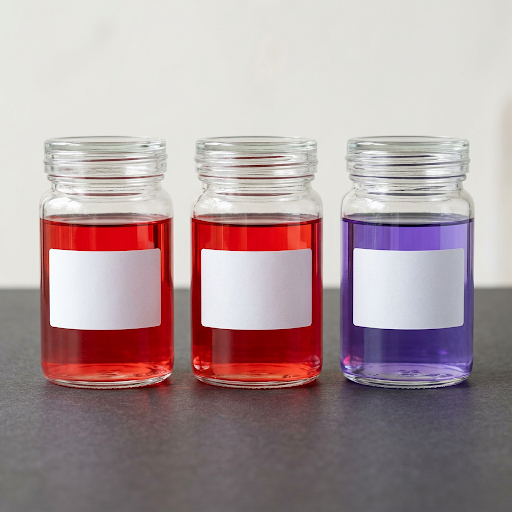
Red mineral-based and purple phosphate ester aviation hydraulic fluid samples shown side by side for comparison

Mineral-Based Hydraulic Fluid (MIL-PRF-5606)

Mineral-based fluids to MIL-PRF-5606 are petroleum products blended with anti-wear, anti-oxidant and viscosity-index additives. They are dyed red and carry the NATO code H-515.

MIL-PRF-5606 offers excellent low-temperature fluidity, generally down to around -54°C, which is why it remains standard in general aviation, older transport aircraft, shock struts and many brake systems. Its limitation is flammability. The flash point is comparatively low, so it is not suitable where fire resistance is a design requirement.

Widely used products include AeroShell Fluid 41 and Nyco Hydraunycoil FH 51.

Synthetic Hydrocarbon Fluid (MIL-PRF-83282 and MIL-PRF-87257)

Synthetic hydrocarbon fluids are based on polyalphaolefin chemistry. MIL-PRF-83282 was developed as a fire-resistant replacement for MIL-PRF-5606, with a substantially higher flash point while using the same seal materials and the same red dye.

The trade-off is viscosity at low temperature. MIL-PRF-83282 is normally limited to approximately -40°C, which restricts its use in very cold operating environments. MIL-PRF-87257 was introduced to close that gap: a lower-viscosity synthetic hydrocarbon that keeps improved fire resistance while extending low-temperature capability to around -54°C.

Because these fluids share seal compatibility with MIL-PRF-5606, many military and defence platforms have been converted from 5606 to 83282 or 87257. The conversion is only valid where the OEM or operating authority has approved it. AeroShell Fluid 31 is a commonly specified MIL-PRF-83282 product.

Phosphate Ester Fluid (Skydrol and HyJet)

Phosphate ester fluids are the standard for commercial transport aircraft. They are governed by airframe specifications such as Boeing BMS 3-11 and the equivalent Airbus requirements rather than by MIL-PRF documents. They are dyed purple and are inherently fire resistant. Skydrol and Mobil HyJet are the two dominant product families.

These fluids are classified by type:

Type V fluids are generally backward compatible with Type IV systems where the airframer permits it. The reverse is not true, so confirm the position for your fleet before making any change.

Aerospace Hydraulic Fluid Comparison

Use this as a first-pass filter, then confirm against the aircraft documentation.

Property MIL-PRF-5606 MIL-PRF-83282 MIL-PRF-87257 Phosphate ester (Type IV/V)
 Base chemistryMineral oilSynthetic hydrocarbonSynthetic hydrocarbonPhosphate ester
 Fluid colourRedRedRedPurple
 Fire resistanceLowImprovedImprovedHigh
 Low-temp limitApprox. -54°CApprox. -40°CApprox. -54°CApprox. -54°C
 Seal materialNitrileNitrileNitrileButyl / EPDM
 Typical useGeneral aviation, struts, brakesMilitary airframes and support equipmentCold-climate military airframesCommercial transport aircraft

How to Choose the Right Aerospace Hydraulic Fluid

1. Start with the OEM documentation, not the specification

The aircraft maintenance manual, consumable materials list or structural repair manual is the governing document. A fluid meeting MIL-PRF-83282 is not automatically approved for your aircraft. The OEM must call out either the specification or the specific product.

Meeting a specification and holding an OEM approval are two separate things. Verify both before raising the order.

2. Confirm the operating temperature envelope

Ambient extremes matter as much as system temperature. An aircraft based in northern Europe or operating from high-latitude airfields can fall outside the MIL-PRF-83282 low-temperature limit, which is exactly the scenario MIL-PRF-87257 was written for.

3. Verify seal and material compatibility

This is where the most expensive mistakes happen. Phosphate ester fluids require butyl or EPDM elastomers and will attack the nitrile seals used with mineral and synthetic hydrocarbon fluids. They also soften many conventional paints, polyurethanes and thermoplastics.

For phosphate ester systems, check the Skydrol material compatibility chart before selecting any adjacent material, and specify Skydrol-resistant products where fluid contact is likely. That includes torque seals, inspection lacquers and marking inks.

4. Establish whether fire resistance is a design requirement

Where a system is routed near hot sections, engine bays or high-temperature bleed air, fire resistance is a design requirement rather than an upgrade. Substituting MIL-PRF-5606 into a system specified for MIL-PRF-83282 removes that protection and is not an acceptable interchange.

5. Check the specification revision and QPL status

Specifications are revised. MIL-PRF-5606 has progressed through revisions H and J, and a product qualified to an earlier revision may not satisfy a current OEM callout.

Confirm the revision letter on the certificate of conformity and check the relevant Qualified Products List. Where full traceability is required, make sure the supplier will provide batch-specific documentation with the delivery.

Aircraft engineer checking the hydraulic reservoir on a commercial aircraft during scheduled maintenance

Mixing and Cross-Compatibility

Phosphate ester and hydrocarbon-based fluids must never be mixed. Cross-contamination is not a performance issue to be monitored. It is a defect requiring system flushing, seal replacement and, in severe cases, component overhaul.

Within the hydrocarbon family, MIL-PRF-5606, MIL-PRF-83282 and MIL-PRF-87257 use compatible seal materials and can often be interchanged where the OEM permits it. Note the two consequences of mixing: adding MIL-PRF-83282 to a 5606 system reduces the low-temperature capability of the charge, and adding 5606 to an 83282 system reduces its fire resistance.

Segregating fluids in the store is the most effective control. Use dedicated dispensing equipment, clear labelling, and separate transfer containers for purple and red fluids.

Condition Monitoring and Service Life

Hydraulic fluid degrades in service. Phosphate ester fluids are particularly sensitive to water ingress, which drives hydrolysis and raises acidity, while chlorine contamination accelerates corrosion of internal components.

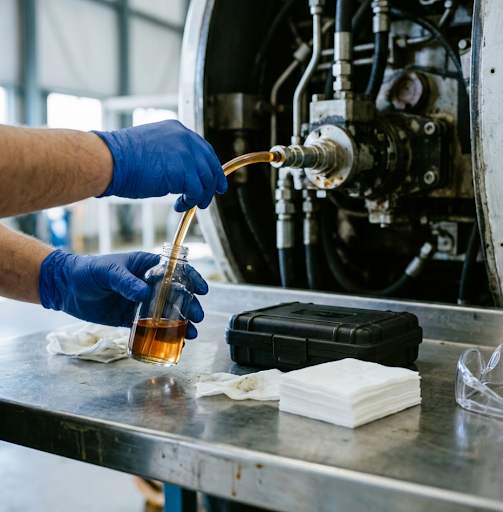
Routine sampling should cover total acid number, water content, chlorine content and particulate cleanliness against the standard named by the OEM. In-service checks can be carried out on wing using a Skydrol test kit, with laboratory analysis used to confirm borderline results.

Storage matters too. Keep containers sealed, upright and within the manufacturer’s stated temperature range, observe shelf life, and rotate stock so older batches are consumed first.

Technician taking a hydraulic fluid sample from an aircraft system for acidity and contamination testing

Do Not Confuse Aircraft Fluid With Strut and Ground Equipment Fluids

Two adjacent product groups are frequently mis-ordered:

  • Shock strut fluids. Landing gear oleos on many Boeing types call for a dedicated fluid to BMS 3-32, such as AeroShell Landing Gear Fluid, rather than the system hydraulic fluid.
  • Ground support equipment fluids. Hydraulic jacks, tugs and test rigs generally use industrial or defence-standard hydraulic oils, which are not approved for aircraft systems.

Checking the application as well as the part number removes the most common ordering error in this category.

Quick Reference: Which Fluid Should You Be Looking At?

 Scenario Fluid to look for Why
 Commercial transport, 3,000 psi systemPhosphate ester Type IV or VAirframe specification and fire resistance
 Higher-temperature or extended-life commercial systemPhosphate ester Type VImproved thermal and hydrolytic stability
 General aviation or legacy transportMIL-PRF-5606Widely approved, excellent low-temperature fluidity
 Military airframe needing fire resistanceMIL-PRF-83282Higher flash point, same seals as 5606
 Military airframe in very cold climatesMIL-PRF-87257Fire resistance plus low-temperature capability
 Boeing landing gear oleo servicingBMS 3-32 strut fluidDedicated shock strut application
 Jacks, tugs and test rigsIndustrial or defence-standard oilNot an aircraft system fluid

Sourcing Aerospace Hydraulic Fluid

Once the specification is settled, the practical questions are availability, pack size and paperwork. Fluids are supplied in quart and litre cans through to 5 US gallon pails and drums. Choosing a pack size that matches your consumption rate reduces the risk of part-used containers exceeding shelf life.

Silmid stocks aviation hydraulic fluids across all three families, supplied with the relevant conformity documentation for airline and defence requirements. For further technical background, see the introduction to hydraulic fluids in the Silmid Knowledge Centre.

If you have the OEM callout to hand, send it to the Silmid technical sales team and we will confirm the correct product, revision and pack size before you order.

Frequently Asked Questions

What are the three main types of aerospace hydraulic fluid?

Aviation uses mineral-based fluids to MIL-PRF-5606, synthetic hydrocarbon fluids to MIL-PRF-83282 and MIL-PRF-87257, and phosphate ester fluids such as Skydrol and HyJet. Mineral and synthetic hydrocarbon fluids are dyed red, and phosphate ester fluids are dyed purple.

Can you mix Skydrol with MIL-PRF-5606?

No. Skydrol is a phosphate ester and MIL-PRF-5606 is mineral-based, and the two require different seal materials. Mixing them damages seals and contaminates the system, requiring a full flush and component inspection.

What is the difference between MIL-PRF-83282 and MIL-PRF-87257?

Both are fire-resistant synthetic hydrocarbon fluids using the same seal materials. MIL-PRF-87257 is the lower-viscosity option, developed to give low-temperature performance to around -54°C, whereas MIL-PRF-83282 is generally limited to approximately -40°C.

Is Skydrol Type V compatible with Type IV systems?

Type V phosphate ester fluids are usually backward compatible with Type IV systems, but approval depends on the airframe and the OEM documentation. Confirm the position for your specific aircraft type before making the change.

How do you know if hydraulic fluid is still serviceable?

Serviceability is assessed by sampling and testing against the OEM limits, typically covering total acid number, water content, chlorine content and particulate cleanliness. Colour or clarity alone is not a reliable indicator of fluid condition.