

Quick View

Every lubricant, grease, hydraulic fluid, and corrosion preventative applied to a UK military aircraft must meet a Defence Standard (DEF STAN) specification. Not a preferred product. Not a close equivalent. The DEF STAN-specified product, drawn from an approved source, with documentation to match. For aerospace maintenance teams working on British military platforms, DEF STAN specifications are not background knowledge - they are the job.
This guide explains how DEF STAN specifications work in the context of day-to-day aerospace maintenance, covers the product families that matter most on the hangar floor, and addresses the documentation and approval requirements that determine whether a maintenance task is closed or grounded.
Defence Standards are technical requirements published by UK Defence Standardization (DStan) on behalf of the Ministry of Defence. In aerospace maintenance, DEF STAN specifications define the performance requirements, chemical composition, and qualification criteria for fluids and lubricants used on military aircraft and support equipment.
The practical difference between a DEF STAN specification and a manufacturer's product recommendation matters enormously in a maintenance context. An aircraft manufacturer may recommend a product by trade name during original build. In MRO, the applicable maintenance manual, Illustrated Parts Catalogue, or Technical Order will reference a specification — typically a DEF STAN number or Joint Service Designation (JSD) — not a brand. The maintenance technician's job is to source a product that meets that specification from an approved source, with the paperwork to prove it.
DEF STAN 01-005 is the master reference document covering all standardised fuels, lubricants, and associated products approved for UK MOD use. It assigns each product a JSD and, where applicable, a NATO code. The full current issue is available as a free download, the DEF STAN 01-005 Blue Book PDF is essential reading for anyone procuring or applying fluids on UK military platforms.
DEF STAN specifications follow a structured numbering format. The prefix "DEF STAN" is followed by a two-part number, for example, DEF STAN 91-079 or DEF STAN 91-047. The first number identifies the subject area; 91 covers petroleum products. The second number identifies the individual specification within that series.
In DEF STAN 01-005, each approved product is also assigned a Joint Service Designation (JSD). The JSD uses a class prefix to identify the product type, followed by a numeric suffix for the specific grade. The most common JSD classes in aerospace maintenance are:
JSD | Class | Typical Application | Common DEF STAN |
OM | Mineral Oils | Turbine engines, hydraulic systems, instruments | DEF STAN 91-098, DEF STAN 91-047 |
OEP | Extreme Pressure Oils | Aircraft gearboxes, helicopter transmissions | DEF STAN 91-100, DEF STAN 91-101 |
OX | Miscellaneous Oils | Instruments, weapons, specialty mechanisms | DEF STAN 91-047, DEF STAN 91-79 |
XG | Greases | Airframe bearings, actuators, undercarriage | DEF STAN 91-053, DEF STAN 91-050 |
PX | Corrosion Preventatives | Storage preservation, post-wash protection | DEF STAN 68-004, DEF STAN 80-004 |
Turbine engine oils are among the most tightly specified consumables in aerospace maintenance. Substituting an incorrect oil grade, using an expired product, or mixing incompatible oil types can cause bearing failure, sludge formation, or seal degradation — none of which becomes apparent until the engine is running.
DEF STAN 91-098 is the primary synthetic polyol ester turbine engine oil specification for current-generation military turbofan and turboshaft engines on UK platforms. It cross-references to MIL-PRF-23699 and carries NATO code O-156. Mobil Jet Oil II is the most widely used product across this specification, qualified to O-156 and in service on the majority of current Royal Air Force and Army Air Corps engine types.
DEF STAN 91-047 (JSD OM-12, NATO O-142) is the general-purpose low-temperature mineral oil used across a range of aircraft instruments, weapons mechanisms, and general lubrication tasks where a synthetic ester base is not required. AeroShell Fluid 3 is the primary DEF STAN 91-047 product in service, cross-referenced to MIL-PRF-7870D and stocked by Silmid with full DEF STAN and NATO code documentation.
Grease selection in aerospace maintenance is a frequent source of specification errors. The three most common mistakes are applying a general-purpose automotive grease to an aircraft component, mixing incompatible thickener systems, and using a product that meets the correct NLGI consistency grade but not the applicable DEF STAN specification. All three will cause issues — and all three are avoidable with the right specification reference.
The NLGI classification guide explains the NLGI grease consistency grading system referenced across DEF STAN grease specifications. The grease specification cross-reference sell sheet maps DEF STAN grease specifications to NATO codes, JSD designations, and qualified products - a practical reference for maintenance teams working across multiple platform types.
DEF STAN 91-053 covers the low-temperature synthetic aircraft grease used on airframe bearings, actuator screw mechanisms, and instrument assemblies requiring lubrication at temperatures down to minus 73 degrees Celsius. It cross-references to MIL-PRF-23827 (NATO G-354, JSD XG-287). Type I (lithium complex thickener) and Type II (organo-clay thickener) must not be mixed. AeroShell Grease 22 is a widely specified multi-purpose aircraft grease covering a range of airframe lubrication tasks across British military platforms.
XG-279 (NATO G-403) is a general-purpose calcium sulfonate complex grease specified for a wide range of airframe and ground support equipment lubrication tasks. Grease XG-279 / G-403 is stocked by Silmid in multiple container formats with full JSD, NATO code, and batch documentation. For guidance on grease selection for specific component types including O-ring assemblies and seals, the aerospace grease selection guide covers compatibility requirements that apply directly to DEF STAN-specified grease products.
Hydraulic fluid specification compliance is non-negotiable in maintenance. Mixing incompatible hydraulic fluid types — for example, a phosphate ester fluid with a petroleum-based fluid — will destroy seals and can cause total hydraulic system failure. The applicable fluid type is defined in the aircraft maintenance manual and must be followed without exception.
DEF STAN 91-100 covers petroleum-based hydraulic fluid for aircraft hydraulic systems not requiring fire resistance. It cross-references to MIL-PRF-5606 (NATO H-515). Nyco Hydraunycoil FH 51 is a qualified H-515 product stocked by Silmid for British military hydraulic system applications.
DEF STAN 91-101 covers synthetic hydrocarbon fire-resistant hydraulic fluid, cross-referencing to MIL-PRF-83282 (NATO H-537). It is not interchangeable with MIL-PRF-5606 / H-515. Seal material compatibility and system flushing requirements apply when transitioning between fluid types. AeroShell Fluid 41 is a widely specified H-537 product. For phosphate ester hydraulic fluid systems, Skydrol LD4 covers aircraft requiring MIL-PRF-87257-equivalent fire-resistant phosphate ester fluid.
Corrosion preventatives in the PX class are applied after maintenance tasks involving washing, component removal, or exposure of bare metal surfaces. They are designed to be temporary, easily removable, rather than permanent coatings. Applying a PX corrosion preventative to a specified component after scheduled maintenance is a task step, not an optional extra.
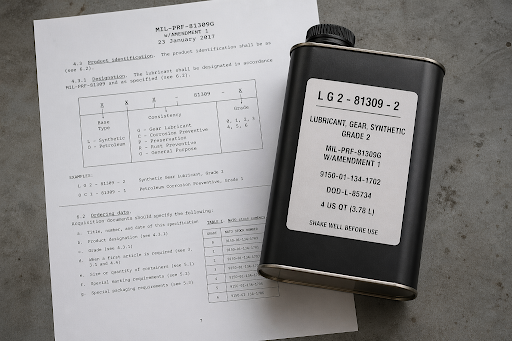
The most important specification distinction in this class is between water-displacing corrosion inhibitors, which rapidly displace moisture and leave a thin protective film and heavier corrosion preventative compounds for longer-term storage and preservation. MIL-PRF-81309 covers water-displacing corrosion inhibitors used for immediate post-maintenance protection. MIL-PRF-16173 covers the heavier corrosion preventative compounds used for scheduled storage and depot-level preservation tasks.
Products stocked by Silmid covering the full DEF STAN PX corrosion preventative range include Ardrox AV8 for light-duty water-displacing protection, Ardrox AV30 for corrosion inhibiting compound applications, and Ardrox AV25 for general-purpose corrosion preventative tasks across aircraft and ground support equipment.
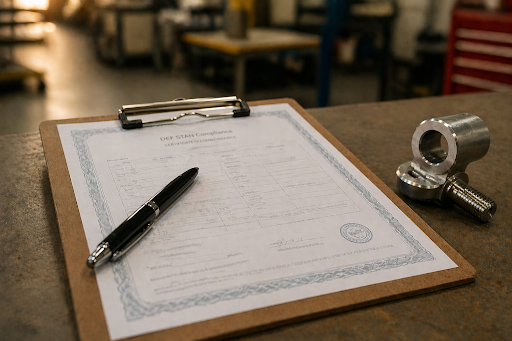
A product meeting a DEF STAN specification is only compliant in a maintenance context if the documentation chain supports it. For UK military maintenance tasks, the certificate of conformance (C of C) accompanying a DEF STAN product must reference the applicable specification number, the JSD where applicable, the NATO code where assigned, the manufacturer batch number, the manufacture date and shelf life expiry, and for aircraft applications, confirmation that the product appears on the Technically Acceptable Products List (TAPL) for that specification.
The TAPL replaced the Qualified Products List (QPL) for UK MOD specifications. Unlike the US DLA QPL database, TAPLs are not publicly searchable. TAPL status is held by the relevant Service Authority, the Defence Strategic Fuels Authority (DFTA) for Army and Air Force aviation products, and DES Ships for Naval aviation. For maintenance organizations, the practical implication is that TAPL confirmation must come through the supply chain documentation rather than a public lookup.
Silmid tip: Always check that the C of C references the DEF STAN specification number and revision, not just the NATO code or JSD. A product supplied with documentation referencing only a NATO code may not satisfy a DEF STAN-specific audit requirement, even where the product itself is identical.
Shelf life management is a maintenance compliance issue, not just a logistics one. Using an expired lubricant on an aircraft component, even if the product appears physically unchanged, is a maintenance error that voids the task certification. DEF STAN 01-005 Section 8 defines minimum shelf life requirements and the inspection procedures for dormant stocks.
For greases and oils, shelf life is typically measured from the date of manufacture and varies by product type. Turbine engine oils and hydraulic fluids in sealed containers under controlled storage conditions generally have longer effective shelf lives than opened containers or products stored in variable temperature environments. Any product approaching shelf life expiry should be inspected against the applicable specification before use, and the Service Authority consulted if life extension is being considered.
Silmid applies first-expiry, first-out stock management to all time-limited DEF STAN products and provides manufacture date, batch number, and remaining shelf life on every certificate of conformance. Minimum remaining shelf life requirements can be specified at order placement for maintenance programs with known task schedules.
A DEF STAN specification defines the detailed performance requirements, test methods, and qualification criteria for a product as required by the UK Ministry of Defence. A NATO code is a standardization identifier assigned to products that meet agreed interoperability requirements under STANAG agreements. Many products carry both — a DEF STAN specification number and a NATO code — but they are not the same thing. The DEF STAN specification is the technical requirement; the NATO code is the interoperability identifier. A product can carry a NATO code without meeting a specific DEF STAN requirement, and vice versa.
Only if the applicable maintenance manual or Technical Order explicitly permits it, or if the product carries dual qualification to both the applicable DEF STAN specification and the equivalent MIL-PRF specification. The certificate of conformance must reference the DEF STAN number — not just the MIL-PRF number — for the product to be acceptable for UK military maintenance tasks. Substitution based on specification equivalence alone, without documentation confirming DEF STAN compliance, is not acceptable. The DEF STAN 01-005 Blue Book lists the DEF STAN to NATO code cross-references that confirm where dual qualification is recognised.
The Technically Acceptable Products List (TAPL) is the UK MOD framework that replaced Qualified Products Lists (QPLs). TAPLs list products that have been assessed as meeting the applicable DEF STAN specification requirements and are held by the relevant Service Authority. For aircraft applications, Product Conformity Certification (PCC) is required, and a product must appear on the TAPL before it can be applied. TAPLs are not publicly searchable. Maintenance organisations and their procurement teams must confirm TAPL status through the supply chain documentation accompanying the product.
The correct specification will be referenced in the aircraft maintenance manual (AMM), component maintenance manual (CMM), or task card for the specific maintenance action. It will typically appear as either a DEF STAN number (e.g., DEF STAN 91-047), a JSD (e.g., OM-12), or a NATO code (e.g., O-142). Any of these can be cross-referenced in DEF STAN 01-005 to identify the full specification requirements and approved product list. If the documentation references a JSD or NATO code but not a DEF STAN number, use the product list in DEF STAN 01-005 to identify the applicable specification before ordering.
Applying an incorrect product is a maintenance error. Depending on the system affected, the consequences range from documentation non-conformance requiring a concession or repeat task, to component damage requiring replacement, to flight safety risk in critical systems such as turbine engines and hydraulic circuits. The maintenance task cannot be certified as complete if the product applied does not meet the specification referenced in the task documentation. The aircraft must remain grounded until the correct product is sourced, applied, and the task re-certified.
Yes. Civilian MRO organisations holding Ministry of Defence approvals to maintain UK military aircraft - including those operating under a MOD Form 765 approval or equivalent - are required to comply with the applicable DEF STAN specifications referenced in the aircraft maintenance documentation. The approval to perform maintenance does not override the specification requirement. Any MRO organisation working on UK military platforms should maintain access to current DEF STAN 01-005 and the relevant DEF STAN 91-series specifications for the aircraft types in their approval scope.