Quick View
Product Code: 
£
Basket
Skip to main content
Published Date: 14th April 2026

MIL-PRF-23699 Explained: How to Choose the Right Turbine Engine Oil

MIL-PRF-23699 is one of the most widely used specifications for turbine engine oils in aviation and industrial applications. It defines the performance requirements for oils used in high-temperature, high-stress turbine environments, ensuring reliability, thermal stability, and long service life.

Understanding this specification and how it compares to other standards can help you select the right oil for your engine, operating conditions, and maintenance requirements. For a broader overview, see our guide to turbine engine oil selection.

MIL-PRF-23699 is a U.S. military performance specification that defines the requirements for synthetic turbine engine oils used in gas turbine engines. Originally introduced decades ago and continuously updated, it remains a benchmark for oil performance in aviation.

This specification ensures that turbine oils can:

  • Withstand extreme operating temperatures
  • Resist oxidation and thermal breakdown
  • Minimise carbon deposits (coking)
  • Provide effective lubrication and cooling
Today, MIL-PRF-23699 oils are used across commercial aviation, military aircraft, and aero-derivative gas turbines in industrial applications. For full specification details, see our resource on MIL-PRF-23699 specification.

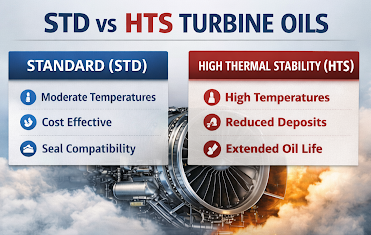
One of the most important aspects of MIL-PRF-23699 is its classification into two main categories: Standard (STD) and High Thermal Stability (HTS).

These oils are often preferred when:

  • Operating temperatures are lower
  • Seal compatibility is important
  • Cost efficiency is a consideration

HTS oils are ideal when:

  • Engines operate at higher temperatures
  • Reduced deposit formation is required
  • Extended oil life and performance are needed

While MIL-PRF-23699 remains a foundational specification, newer standards such as SAE AS5780 were developed to address evolving engine technology and higher operating temperatures.

SAE AS5780 introduces more stringent testing and additional performance categories, particularly for advanced turbine engines. These oils are often classified into Standard Performance Capability (SPC) and High Performance Capability (HPC) grades.

In many cases, turbine oils meet both MIL-PRF-23699 and SAE AS5780 specifications, but selecting the right one depends on engine requirements and manufacturer approvals. For a side-by-side comparison of specifications, grades, and equivalent products, download our turbine engine oil cross-reference guide.

In practice, selecting between STD and HTS oils often depends on operating temperature thresholds, maintenance intervals, and OEM approvals for specific engine platforms, particularly in high-load or high-cycle applications.

Choosing the correct turbine engine oil involves more than selecting a specification. You should consider the following factors:

  • Engine requirements and OEM approvals
  • Operating temperature and thermal demands
  • Application type such as aviation or industrial use
  • Maintenance strategy and oil monitoring practices

MIL-PRF-23699 oils are used across a wide range of applications, including:

  • Commercial and military aircraft engines
  • Auxiliary power units (APUs)
  • Helicopter gearboxes
  • Aero-derivative gas turbines (ADGT)

Their performance characteristics make them suitable for environments where reliability and thermal stability are critical.

Several turbine engine oils meet MIL-PRF-23699 specifications and are available across different performance grades. Browse available turbine engine oils to compare options by specification and application.

  • AeroShell Turbine Engine Oil 500 (STD)
  • AeroShell Turbine Engine Oil 560 (HTS)
  • Mobil Jet Oil II
  • Eastman Turbo Oil 2380
  • Nyco Turbonycoil 600

These products are designed to meet the demands of modern turbine engines while complying with industry standards and approvals.

MIL-PRF-23699 remains a key standard for turbine engine oils, helping ensure consistent performance across aviation and industrial environments. Understanding the differences between STD and HTS oils, along with how they relate to newer specifications, allows for more informed decision-making.

To find the right turbine engine oil for your needs, explore Silmid's full range of approved products or consult available technical resources for additional guidance.

Frequently Asked Questions About MIL-PRF-23699

What is MIL-PRF-23699?

MIL-PRF-23699 is a military performance specification for synthetic turbine engine oils used in aviation and industrial gas turbine applications. It defines requirements for thermal stability, oxidation resistance, and overall performance under high-temperature conditions.

What is the difference between STD and HTS turbine oils?

STD (Standard) oils are designed for moderate operating temperatures, while HTS (High Thermal Stability) oils are formulated for higher temperature environments and improved resistance to carbon deposits.

Is MIL-PRF-23699 still used today?

Yes, MIL-PRF-23699 remains widely used across aviation and industrial applications. Many modern turbine oils meet this specification alongside newer standards such as SAE AS5780.

Can oils meet both MIL-PRF-23699 and SAE AS5780?

Yes, many turbine engine oils are designed to meet both specifications. However, selecting the correct oil depends on engine manufacturer approvals and operating requirements.

How do I choose between STD and HTS oils?

The choice depends on engine operating temperature, OEM recommendations, and maintenance requirements. HTS oils are typically used in higher temperature applications, while STD oils may be preferred for compatibility and cost considerations.