Mineral vs Phosphate Ester: The Compatibility Divide
This is where the most damaging errors happen. The two worlds use fundamentally different elastomers and system materials, so cross-contamination is not a minor issue: it degrades seals, swells or shrinks components, and can take a system out of service.
| Property | Mineral / synthetic hydrocarbon | Phosphate ester |
| Typical specs | MIL-PRF-5606, 83282, 87257 | SAE AS1241 (Skydrol, HyJet) |
| Colour | Red | Purple |
| Fire resistance | 5606 low; 83282/87257 high | High |
| Typical aircraft | GA, military, legacy | Large commercial transport |
| Seal type | Nitrile / mineral-compatible | Butyl / EPDM |
| Cross-compatible? | Within family, with caution | Never with mineral fluids |
The rule is simple and absolute: never mix mineral-based and phosphate ester fluids, and never use one where the other is specified. Even small residual amounts during a fluid change can cause problems, which is why flushing procedures and material compatibility.
MIL-PRF-5606: The Mineral Baseline
MIL-PRF-5606 is a US military specification for red mineral-based aircraft hydraulic fluid with excellent low-temperature performance. It is widely used in general aviation, legacy aircraft, and military systems, but is flammable, which led to the development of fire-resistant synthetic hydrocarbon alternatives.
MIL-PRF-5606 (NATO H-515) remains one of the most widely specified hydraulic fluids in aviation, valued for its excellent flow at very low temperatures. Its main limitation is flammability, which is why fire-resistant fluids were developed for applications where fire risk is a greater concern than cold-start performance. See the MIL-PRF-5606 specification page for full detail and approved products.
MIL-PRF-83282 and MIL-PRF-87257: Fire-Resistant Synthetics
MIL-PRF-83282 is a fire-resistant synthetic hydrocarbon hydraulic fluid developed as a safer replacement for MIL-PRF-5606. MIL-PRF-87257 is a lower-viscosity development of 83282, offering better low-temperature performance for cold-climate and high-altitude operation while keeping fire resistance and broad backward compatibility.
MIL-PRF-83282 (NATO H-537) was introduced specifically to reduce the fire hazard of MIL-PRF-5606 while remaining compatible with the same systems and seals. Its trade-off is poorer low-temperature flow, which is exactly the gap MIL-PRF-87257 was created to close.
In practice, many operators favour 83282 or 87257 where fire safety is a priority, and reserve 5606 for systems that genuinely require its extreme cold performance or that are only approved for it. Full detail is on the MIL-PRF-83282 specification page and the MIL-PRF-87257 specification page.
Phosphate Ester Fluids: Skydrol and HyJet
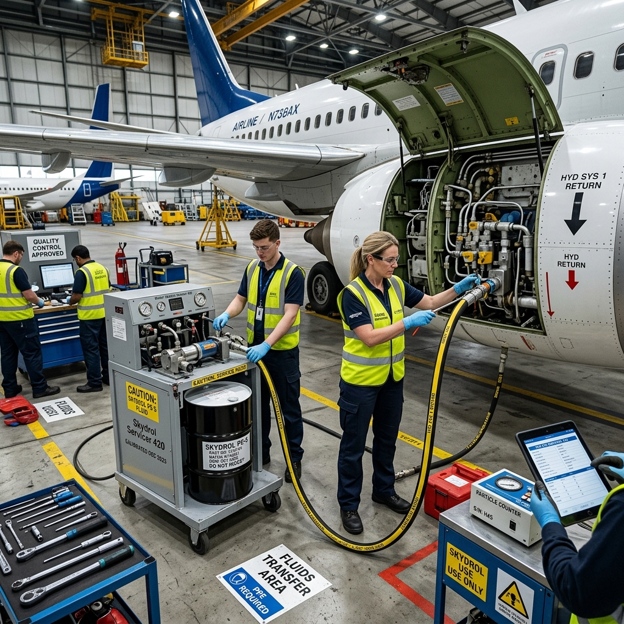
Phosphate ester hydraulic fluids such as Skydrol and Mobil HyJet are fire-resistant fluids used in most large commercial transport aircraft. They are qualified to SAE AS1241 and airframe specifications, are purple in colour, and require dedicated seals and handling. They are never compatible with mineral-based fluids.
Phosphate ester fluids dominate large commercial aviation because of their inherent fire resistance under high-pressure operation. They demand specific handling: dedicated seals, compatible coatings and markings, and careful skin and material protection. Within the phosphate ester family, products and grades still differ, so the airframe-approved grade must be matched precisely.
Because compatibility is so critical here, a material compatibility check is often needed before introducing the fluid to a component. Our Skydrol material compatibility resource is a practical reference for confirming which sealants, markings, and materials are suitable.