Turbine Engine Oils
Turbine engine oils have similar uses as piston engine oils, but have been adapted to work in the different engine format. They lubricate the moving parts to reduce friction and allow the engine to run smoothly.

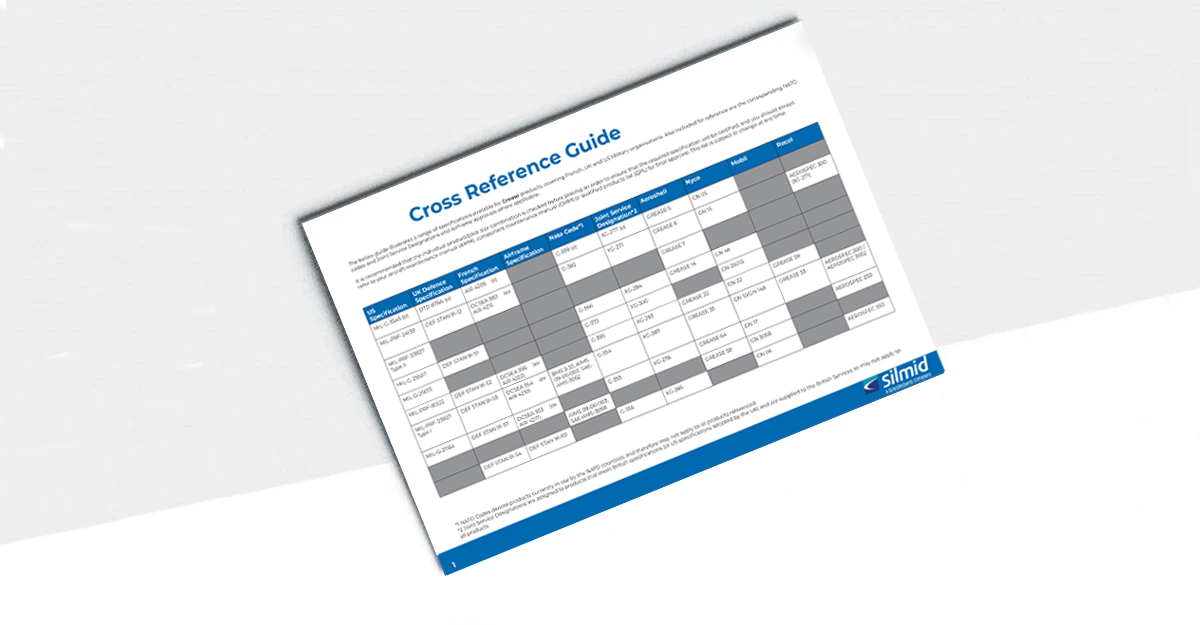
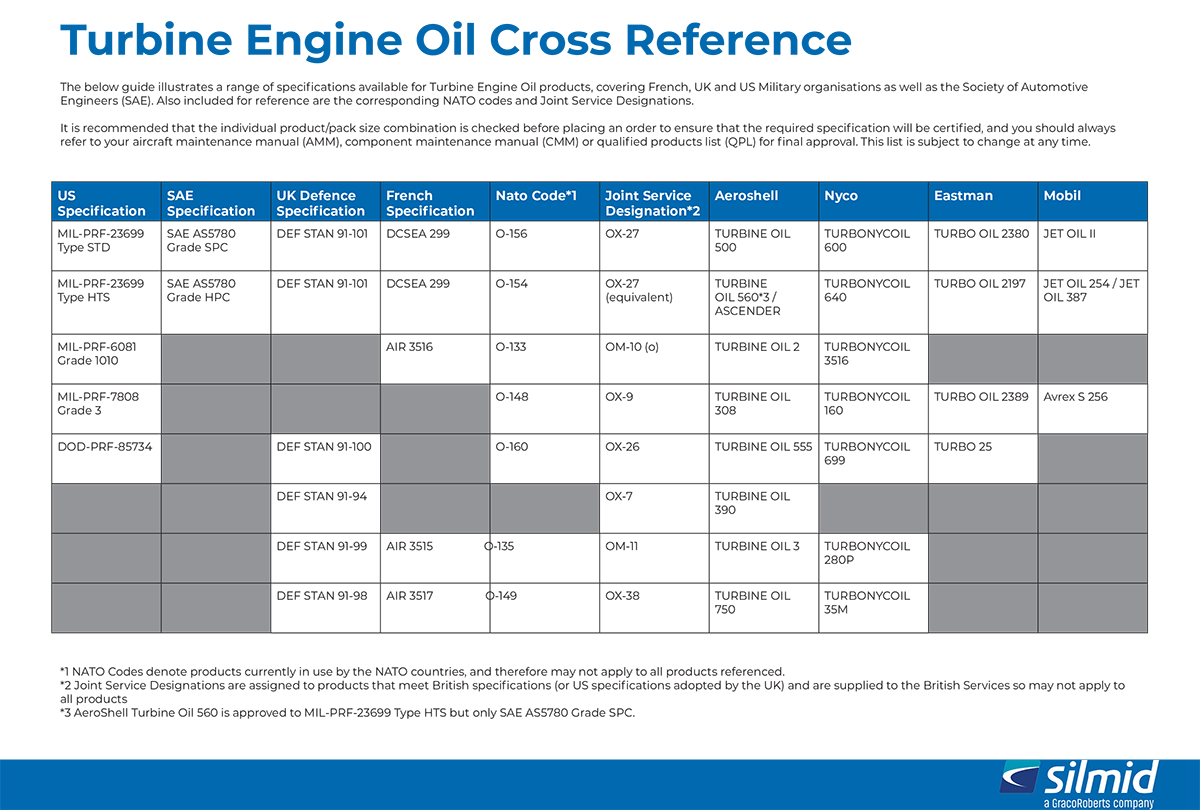
Silmid’s TEO Lubricant Cross-Reference Guide provides an essential reference tool for matching specifications of turbine engine oils. This guide helps maintenance teams, technicians, and procurement specialists quickly align French, UK, and US military specifications with corresponding NATO codes and Joint Service Designations. By ensuring the correct lubricant is sourced, organisations can maintain compliance, prevent component failures, and support aircraft safety and operational readiness.
The below guide illustrates a range of specifications available for Turbine Engine Oils, covering French, UK, and US Military organizations. Also included for reference are the corresponding NATO codes, Joint Service Designations, and Airframe approvals where applicable. It is recommended that the individual product/pack size combination is checked before placing an order to ensure that the required specification will be certified.
*Always confirm technical suitability with OEM data sheets before selecting or substituting a hydraulic fluid product.
It is a tool that maps various international and military specifications for Turbine Engine Oils to ensure the correct product selection for MRO operations.
Using an oil that doesn't meet the required specification can lead to component failure, void warranties, and breach strict regulatory or maintenance compliance standards, which is highly critical in aerospace.
These codes (e.g., O-155, DEF STAN) are standardised classification systems used by member countries and militaries to ensure oils are functionally equivalent regardless of the specific manufacturer or commercial brand. When sourcing, matching the NATO Code or Joint Service Designation is often a primary requirement for compliance.
This guide is primarily used by MRO facilities, aerospace engineers, defence contractors, and procurement teams responsible for sourcing aviation lubricants.
No, this guide does not guarantee engine approval. Engine approval is determined by the Original Equipment Manufacturer (OEM), such as Pratt & Whitney or Rolls-Royce, and is documented in your Aircraft Maintenance Manual (AMM) or Component Maintenance Manual (CMM). Always check the OEM's Qualified Products List (QPL) for final acceptance.